

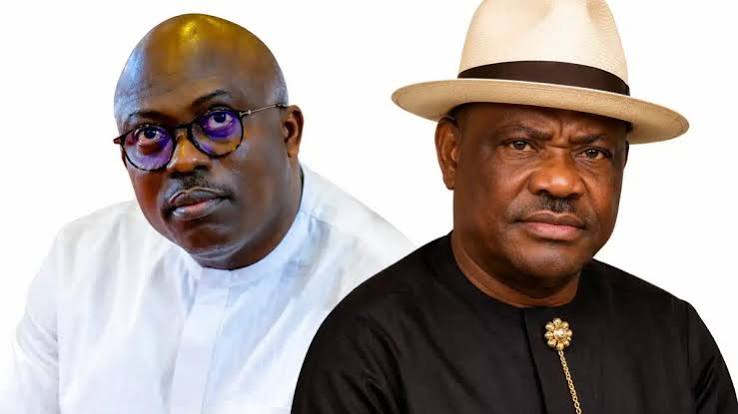
Rivers State Governor Siminalayi Fubara has told his supporters to stop addressing him as their political leader, declaring that they now have a common leader following his reconciliation with the political camp of Federal Capital Territory (FCT) Minister Nyesom Wike.
Fubara made the statement on Tuesday, October 27, 2026, during a political rally at the Yakubu Gowon Stadium in Port Harcourt, where candidates of the Rainbow Coalition were unveiled ahead of the 2027 general elections.
The governor, who was assigned to unveil the coalition’s candidates, also presented the All Progressives Congress (APC) flag to Hon. Ogundu Kingsley Chinda, identified in the report as Wike’s preferred governorship candidate.
Addressing supporters at the gathering, Fubara recalled that some of those who stood by him during the political crisis in Rivers State continued to refer to him as their leader.
He urged them to abandon the practice, saying the political camps had now reunited.
“We are now in one house. And because we have one house, there is no issue about who is the leader,” the governor said.
He added: “I might be your oga (governor) but we have a common leader now. So, please, going forward, this issue of ‘my leader, my leader, my leader’, I want it resolved here and now.”
How the Wike-Fubara reconciliation unfolded
The development follows a series of reconciliation meetings between Wike’s Rainbow Coalition and Fubara between August 16 and October 7, 2026, according to the report.
The meetings reportedly took place at the governor’s private residence in Port Harcourt and involved political stakeholders from across the state, including the 23 local government chairmen, lawmakers and political appointees.
Fubara was said to have agreed to return to the political group, while three lawmakers previously suspended during the crisis were reinstated. Members of the governor’s political camp were also reportedly promised positions in the next political dispensation.
The reconciliation followed a prolonged political crisis in Rivers State, which led to President Bola Tinubu declaring a state of emergency in the state on March 18, 2025.
Questions over Fubara’s political position
Fubara’s latest statement has generated different interpretations among political stakeholders, particularly over the extent of Wike’s influence in Rivers politics and the governor’s political future.
Public commentator Franklin Uket alleged that Wike wanted to retain control of the state’s political structure and argued that the governor had been pressured into surrendering his independent political position.
The Paramount Ruler of Egwebe in Andoni Local Government Area, HRH Ubokikwan Gabriel Ogbologwung, also criticised Fubara’s decision. He expressed concern that the governor’s move could weaken the confidence of supporters who stood by him during the political crisis.
Chief Anabs Sara-Igbe, an elder statesman of Ijaw extraction, similarly suggested that Fubara might have found himself in a difficult political situation. He warned that the decision could affect the political balance in Rivers State.
However, former House of Representatives member Prince Ogbonna Nwuke offered a different perspective, arguing that the governor’s action could be understood as an attempt to secure peace.
“There is nothing too big for anybody to do to bring peace. You can’t have two masters in the same boat,” Nwuke said.
He added that only Fubara could explain why he chose to relinquish his position as the political leader of the state.
President of the Pan Niger Delta Elders Forum (PANDEF), Prof. Godknows Igali, also defended the governor’s right to make the decision, noting that Fubara was entitled to either retain or relinquish political authority.
What the development could mean for 2027
Fubara’s declaration has renewed attention on the political arrangement between the governor and Wike ahead of the 2027 elections.
Although the Rainbow Coalition has brought the two camps together, questions remain about the governor’s influence within the alliance, the future of his supporters and how political interests will be negotiated before the next governorship election.
The extent to which Fubara’s supporters will embrace the new arrangement, and whether the reconciliation will hold through the 2027 election cycle, remains to be seen.
